Heat treatment is an important means to improve the properties of TC20 titanium alloy. |
Introduction to straightening methods for titanium rods, wires, and tubes
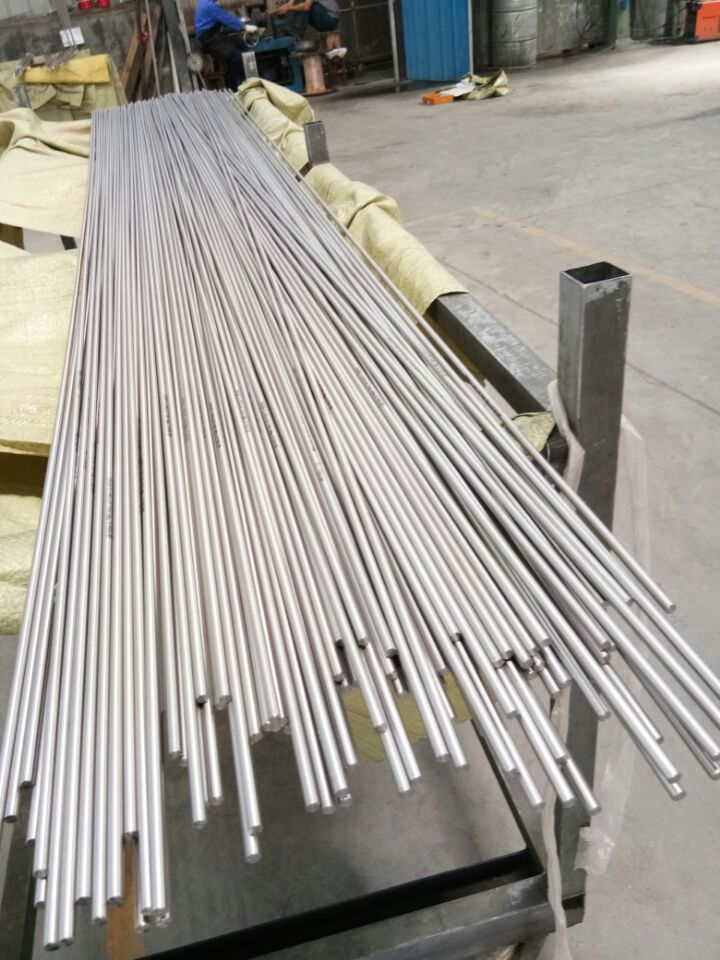
The common straightening methods for rod wire and titanium tube include tension straightening, sine straightening, pressure straightening, etc. Tension straightening is a processing method that applies longitudinal tension beyond the yield limit of the material to the workpiece, causing plastic extension and achieving shape defect correction, also known as drawing straightening. During straightening, tensile stress exceeding the yield limit of the material is applied to the titanium rod, titanium wire, and titanium tube with wavy defects on the tension straightening machine. The tensile stress is superimposed with the residual stress of the titanium rod, and at the point of greater extension, a portion of the tensile stress is cancelled out, resulting in a decrease in the actual deformation stress and a smaller plastic extension during straightening; At the original location where the extension was small, due to the superposition of tensile stress, the actual deformation stress increased, and the plastic extension during straightening increased. As a result, after being straightened by tension, all parts of the workpiece extended evenly, and the wavy defect was eliminated. The sine straightening method is widely used in the production of simple cross-section bar wire materials and pipes. Titanium tubes and rods are processed on an inclined roller straightening machine. The number of rollers in a straightening machine is greater than 4 (usually 5-29 rollers), and its working principle is to gradually reduce the range of residual curvature of the workpiece by continuously and repeatedly bending the workpiece at three points through each roller. Sine straightening is usually used in conjunction with pressure straightening. Firstly, workpieces with high curvature are straightened by a pressure straightening machine, and then subjected to inclined roller straightening. The straightening effect mainly depends on the pressure of the straightening machine and the inclination angle of the rollers. The magnitude of pressure depends on the yield strength and curvature of the alloy material. If it is a high-strength titanium alloy, the straightening pressure should be higher when the curvature is large, and vice versa. The size of the roll angle depends on the diameter of the workpiece, and workpieces with larger diameters should have a larger straightening angle than those with smaller diameters. After straightening, the unqualified workpieces should also be returned for re straightening. Titanium pipes that cannot be straightened should be sent to a tension straightening machine for straightening. The basic principle of roll straightening is: (1) Generally, the smaller the roller diameter and the more rollers there are, the higher the straightening accuracy; A small roller spacing value is beneficial for establishing the biting and straightening process of the workpiece. (2) The main function of the first few rollers in roll straightening is to reduce the difference in residual curvature along the length direction of the workpiece, while the main function of the last few rollers is to reduce the residual curvature that tends to be uniform. (3) The quality of straightening mainly depends on the reasonable determination of the anti bending curvature of the workpiece under each roller. Select a large anti bending curvature on the first few rollers (second and third rollers), and determine the anti bending rate on the subsequent rollers based on the maximum residual curvature that can completely straighten the adjacent rollers in front. (4) The larger the hardening coefficient of 7, the more difficult it is to straighten the material. In this case, a larger anti bending rate, more straightening rollers, and smaller roller diameters should be selected.
|